
Toilet Training: A Speech-Language Pathologist's Guide
- Mar 29, 2018
- 5 min read
Updated: Jul 26
Toilet training is a major milestone — and for many parents, it's also a genuine source of stress, especially as a child approaches the start of (play)school. Most children show readiness for toilet training around age two, but it's worth remembering that both physical and emotional readiness matter before starting the process, not just age alone.
As a speech-language pathologist, I see toilet training through a slightly different lens: it's not just a self-care milestone, it's also a language-rich opportunity. Speech and language techniques can genuinely support the toilet training process — here's how.
Building Understanding Before You Begin
Helping your child understand what the toilet is and how it's used is a foundational part of toilet training. A few ways to strengthen this receptive understanding:
Label the Toilet Door

Pair a simple visual with the word "toilet" on the bathroom door your child will be taken to. This helps your child build familiarity with exactly where they're being taken each time, reducing confusion and anxiety around the process.
Prepare Your Child Ahead of Time
Your child needs a clear sense of what's going to happen before training begins. Reading books together, or using photos, is a great way to introduce the idea — explaining that everyone uses the toilet, how to recognize the feeling of needing to go, and the full routine: sitting on the seat, washing hands, and cleaning up if there's an accident.
There are plenty of potty-training books available commercially, but you can also make your own, customized to your child's actual home and routine. Personally, I like building this book together with the child, using real photos of their own house and environment — it makes the process feel familiar rather than abstract.
Keep Visuals Ready During Toileting
Using the toilet involves several sequential steps, and having those steps visually available while your child is actually in the bathroom makes a real difference. Simple photos or drawings your child can relate to work well here.
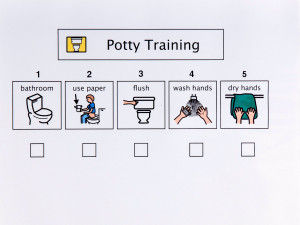
Reviewing these visuals before or during toilet use — flushing, washing hands, closing the door — helps reinforce the sequence and gives your child a reliable reference point each time.
Helping Your Child Express the Need to Go
Alongside building understanding, your child needs a reliable way to communicate when they need to use the toilet. Here's how to build that expressive side.
Teach a Simple Gesture
When a child can't yet use words to express a need, gestures are genuinely valuable. Teaching a simple, consistent gesture for "toilet" gives your child an early way to communicate the need. Start by having your child imitate the gesture every time they're taken to the toilet — over time, many children begin using the same gesture independently, without a prompt.
Use Toileting Words Consistently
Your child needs to hear language around toileting consistently, every time they're taken to use the bathroom. This builds the language environment they need to eventually use these words themselves. Start simple — "toilet time," "pee pee," "poo," "sit," "flush," "wash" — and as your child starts using those individual words, gradually build toward short phrases and sentences: "Going to the toilet," "Time to pee," "Sit on the toilet." Don't forget to layer in praise and reinforcement along the way — it helps your child start using positive language themselves, too.
Don't Skip Emotional Language
Emotional vocabulary often gets left out of toilet training, but it matters. Children experience real emotions throughout this process — words like "happy" or "embarrassed" are worth naming at the right moments, though never in a way that shames your child. Using these words consistently helps your child start relating to and eventually using them too.
Let your child hear and use words of praise that you model for them. Celebrate the small steps — removing pants or a diaper independently, helping clean up after an accident — all of it is worth acknowledging. In the early stages, I tend to praise generously and often; over time, I space that praise out and focus it specifically on successful toilet use.
A Few Final Thoughts
Toilet training isn't just a physical milestone — it's a genuine language and communication opportunity, and approaching it that way can make the whole process feel less stressful for both you and your child. Let these tips guide you as you get started, and remember that every child moves through this at their own pace.
If you have concerns about your child's communication development alongside toilet training — limited gestures, minimal word use, or difficulty following simple routines — it may be worth a conversation with a speech-language pathologist.
Book a free screening with 1SpecialPlace if you'd like professional guidance on your child's communication milestones.
Tell us what's worked for your child during toilet training — we'd love to hear from you.
Subscribe to receive more articles like this.
Frequently Asked Questions
At what age should toilet training start?
Most children show signs of readiness around age two, though this varies. Readiness depends on both physical development (bladder control, motor skills) and emotional readiness — not age alone, so it's worth watching for your child's individual cues rather than following a strict timeline.
How can I help a nonverbal or minimally verbal child with toilet training?
Gestures are especially valuable here. Teaching a simple, consistent gesture for "toilet" — paired with visuals and a predictable routine — gives your child a reliable way to communicate the need to go, even before they have the words for it.
Should I use visuals during toilet training even if my child is verbal?
Yes. Visual supports help any child understand and remember the sequence of steps involved in using the toilet — sitting, flushing, washing hands — regardless of their verbal ability. They're especially useful for children who benefit from predictable, step-by-step routines.
What if my child has an accident during the toilet training process?
Accidents are a normal, expected part of the process. Using calm, consistent language to talk your child through cleanup — without shame or frustration — helps keep the process emotionally safe and supports steady progress over time.
Is toilet training harder for children with speech or developmental delays?
It can take more structured support, but it's very achievable. Children with speech or developmental delays often benefit even more from the visual, gesture-based, and consistent-language strategies outlined above, since these approaches build in extra clarity and predictability.
Related Reading & Support Resources
Explore more communication and development support at 1SpecialPlace:
Speech and Language Delay Therapy — for children with limited gestures, words, or communication skills
Occupational Therapy for Children — supporting self-care and daily living skills like toileting
Autism Spectrum Disorder Treatment — communication-focused support for children on the spectrum
Book a Free Screening — get expert guidance on your child's communication milestones
External resources on toilet training and child development:


Comments